Johathan Ritchey has invented the Watermill, which is an atmospheric water generator. It converts air into fresh water.
This
latest technology invention produces fresh water at a cost of about 3
cents a liter (1 quart). Originally designed for areas that do not have
clean drinking water, the Watermill is for households that prefer an
eco-friendly, cost effective alternative to bottled water. Atmospheric
water generators convert air into water when the temperature of the air
becomes saturated with enough water vapor that it begins to condense
(dew point). "What
is unique about the Watermill is that it has intelligence," says
Ritche. This makes the appliance more efficient. It samples the air
every 3 minutes to determine the most efficient time to convert the air
into water. It will also tell you when to change the carbon filter and will shut itself off if it cannot make pure clean water.
A new prototype house walked around the campus of the Wysing Arts Centre in Cambridgeshire, England.
The
eco-friendly house is powered by solar cells and minature windmills,
and comes with a kitchen, a composting toilet, a system for collecting
rain water, one bed, a wood stove for CO2 neutral heating, a rear
opening that forms a stairway entrance, and six legs.
A collaborative effort
between MIT and the Danish design collective N55, the house walks about
five kilometers an hour similar to the walking speed of a human.
The
legs reguire a software algorithm to calculate the movement and
position of the legs to provide stability over varying terrain.
The house can turn, move forward or backwards, or change height as
required and can be programmed with GPS waypoints for travelling to
destinations.
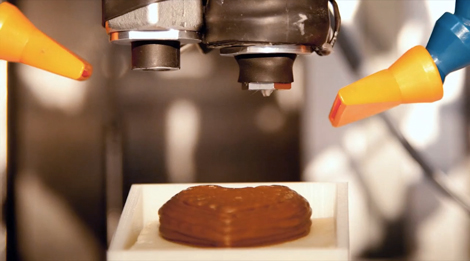
Researchers at Britain’s University of Exeter have developed a 3-D printer that Willy Wonka would die for. Instead of using metals or plastics as its “ink,” Exeter’s uses chocolate. Sometimes called additive manufacturing, 3-D printing technologies work off a three-dimensional CAD design of a product, then construct the item by laying down one very thin layer of material at a time. But this is the first time researchers have used chocolate as a medium.
It’s not proved easy: Chocolate doesn’t flow properly unless it is
heated and cooled to precise temperatures. The team, led by Liang Hao, a
materials scientist in Exeter’s College of Engineering, developed new temperature and heating control systems
to make the prototype printer work. Hao envisions the day when
consumers can download CAD software, create a design (or modify an
existing one), send it to a shop, and pick up their self-designed sweet treat 10 minutes later. Not surprisingly, several chocolate retailers are already expressing interest in the invention. Although chocolate is hard to work with, it is much tastier than plastic.
In October 2009, James Dyson's consumer electronics company, famous for its line of vacuum cleaners,
introduced a new device to the market called the Dyson Air Multiplier.
The Air Multiplier is a fan with an unusual characteristic: it doesn't
have any visible blades. It appears to be a circular tube mounted on a
pedestal. The shallow tube is only a few inches deep.
Looking at
the device, you wouldn't expect to feel a breeze coming from the mounted
circle. There are no moving parts in sight. But if the fan is switched
on, you'll feel air blowing through the tube. How does it work? How can
an open circle push air into a breeze without fan blades?
As you
might imagine, there are a few scientific principles at play here.
There's also an electronic element. While the tube doesn't have any
blades inside it, the pedestal of the fan contains a brushless electric motor
that takes in air and feeds it into the circular tube. Air flows along
the inside of the device until it reaches a slit inside the tube. This
provides the basic airflow that creates the breeze you'd feel if you
stood in front of the fan. Dyson claims that the Air Multiplier
generates a breeze with 15 times more air than what the device actually
takes in.
According to Dyson, the breeze generated by the Air
Multiplier is more consistent and steady than one from a standard fan
with blades. Since there are no rotating blades, the breeze from the fan
doesn't buffet you with short gusts of air.
What's the secret behind the technology?
The Mechanics of the Air Multiplier
Calling the Dyson Air Multiplier a fan with no blades is perhaps a
touch misleading. There are blades in the fan -- you just can't see
them. The pedestal hides the blades. A motor rotates nine
asymmetrically-aligned blades to pull air into the device. According to Dyson, these blades can pull in up to 5.28 gallons (about 20 liters) of air per second.
The
air flows through a channel in the pedestal up to the tube, which is
hollow. The interior of the tube acts like a ramp. Air flows along the
ramp, which curves around and ends in slits in the back of the fan.
Then, the air flows along the surface of the inside of the tube and out
toward the front of the fan. But how does the fan multiply the amount of
air coming into the pedestal of the device?
It boils down to
physics. While it's true that the atmosphere is gaseous, gases obey the
physical laws of fluid dynamics. As air flows through the slits in the
tube and out through the front of the fan, air behind the fan is drawn
through the tube as well. This is called inducement. The flowing air pushed by the motor induces the air behind the fan to follow.
Air surrounding the edges of the fan will also begin to flow in the direction of the breeze. This process is called entrainment.
Through inducement and entrainment, Dyson claims the Air Multiplier
increases the output of airflow by 15 times the amount it takes in
through the pedestal's motor.
Upon its launch, Dyson made
available two sizes of the Air Multiplier. The larger model has a fan
with a 12-inch diameter (about 30.5 centimeters). The smaller model has a
10-inch diameter (25.4 centimeters). The stylish fans weren't cheap --
the smaller model's suggested retail price was $299.99, while the larger
fan would cost you $329.99. That's a pretty steep price for a device
that pushes air at you.
There's no question that the Dyson Air Multiplier is a striking invention.
Its sleek design and innovative technology set the blogosphere abuzz
when it launched. Perhaps in the future none of our fans will have
visible blades.


 A
A